FAQs about One Touch Push Lock Clamps
Durability testing is conducted under no-load conditions by repeatedly clamping and unclamping the product.
The durability test results are shown below.
Please note that durability may vary depending on the customer’s operating conditions. The results are provided as reference values and are not guaranteed values.
| Series | Durability Test Cycles |
|---|---|
| QCPS | 30,000 cycles |
The heat-resistant temperature is 80°C for both plastic-handle and metal-handle models.
Please refer to the heat-resistant temperature when evaluating product suitability.
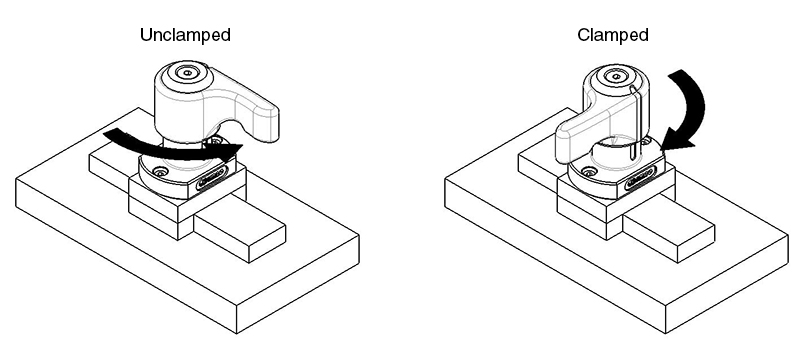
Operating torque refers to the torque required to turn the handle to the clamped or unclamped position.
The operating torque is almost the same for both clamping and unclamping.
Please refer to the table below for the operating torque. The torque values may vary slightly.
| Series | Operating Torque (N・m) |
|---|---|
| QCPS0828-6 | 0.5 |
| QCPS1036-6 | 1.2 |
The datasheet provides the sliding load and holding torque values for SUS303 material. Testing has also been conducted for other materials.
Please refer to the PDF below for the test results.
Sliding Load and Holding Torque by Mating Component MaterialNo.
This product is not designed with waterproof or dustproof protection.
In environments where the product is exposed to water or dust, water or dust may enter the internal mechanism and impair product operation or function. Please use caution.
No.
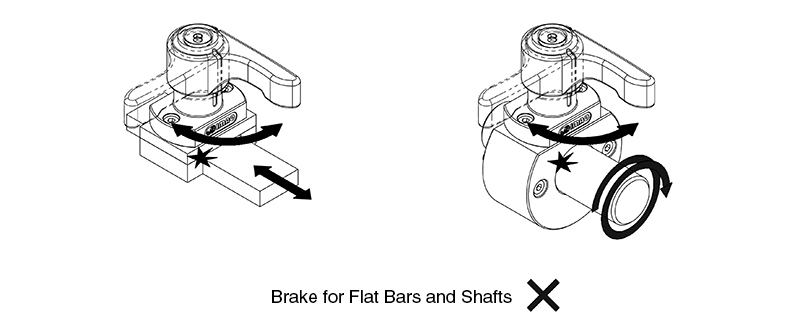
Clamp and unclamp this product only when the mating component has come to a complete stop.
This product is not intended for use as a brake for moving slide shafts or rotating shafts.
Do not use the product for braking applications, as this may damage internal components or scratch the mating component.
Yes.
This product can be used as a clamping component for linear rail applications.
For mounting to a linear rail, use the QCPSLA Linear Rail Clamp Mounts or a customer-made mounting attachment.
Linear Rail Clamp MountsFor details on fabricating a custom mounting attachment, please refer to the PDF below.
Linear Rail Mounting