FAQs about Heavy Duty Knob-Locking Pins
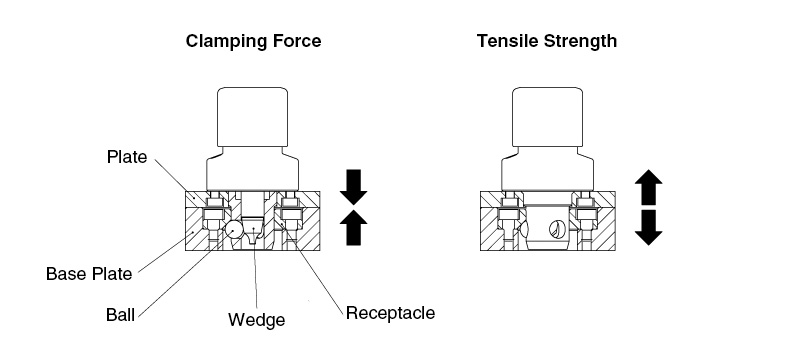
Clamping force refers to the force generated when the balls pushed outward by the wedge contact the tapered surface inside the receptacle, pulling the plate inward.
If a tensile load exceeding the clamping force is applied, a gap may occur. However, the holding force refers to the ability to maintain the gap between the plates within 0.1 mm.
Tensile strength refers to the maximum load that the clamp can withstand when the plate is pulled away from the base.
Even when a tensile load exceeding the clamping force is applied, a gap may occur between the plates, but the wedge structure minimizes the gap.
Please refer to the technical data of each product below for details.
| Part Number | Clamping Force (N) | Holding Force (N) | Tensile Strength at Failure (N) |
|---|---|---|---|
| QCWES1225-16S | 1000 | 2500 | 4000 |
| QCWES1634-20S | 2000 | 5000 | 8000 |
Yes.
This product can be used in applications subject to offset (moment) loads.
Please refer to the PDF below for guidelines on load calculations, gap generation, and precautions regarding product failure before determining suitability.
No.
The Mechanical Strength values do not include a safety factor.
These values represent the load levels at which failure can occur and should not be considered allowable loads.
| What is the durability of the product? | Shear Strength at Failure (N) | Tensile Strength at Failure (N) |
|---|---|---|
| QCWES1225-16S | 10000 | 4000 |
| QCWES1634-20S | 15000 | 8000 |
Durability testing is conducted under no-load conditions, focusing on repeated clamping and unclamping of the clamper.
The results of the durability tests are shown below for reference when evaluating product suitability.
| Part Number | Durability Test Cycles |
|---|---|
| QCWES1225-16S | 30,000 cycles |
| QCWES1634-20S |
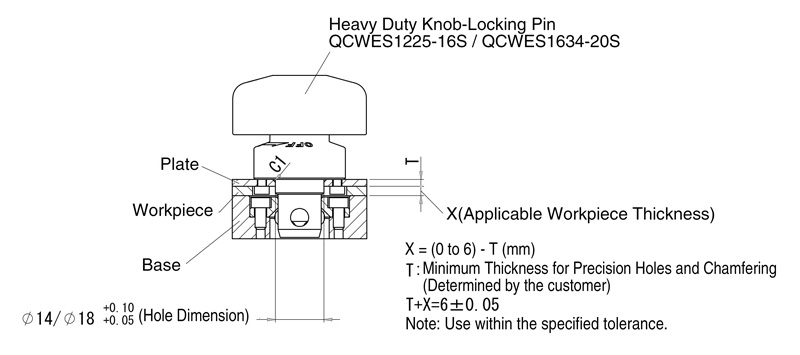
Yes, provided that the combined thickness of the workpiece and the mounting plate is within the T dimension specified in the catalog (tolerance: ±0.05 mm).
However, inserting a workpiece reduces the thickness of the mounting plate. Therefore, it is recommended to ensure sufficient plate thickness to allow for precision holes and chamfering.
As the required mounting thickness varies depending on the clamp model, please refer to the figure below for details.
Yes.
When mounted on a vertical surface, the moment load generated by the weight of the workpiece may cause a gap between the plates.
When used in a hanging position, a gap may occur if the weight of the workpiece exceeds the clamping force.
Please refer to the table below for details.
| Part Number | Clamping Force (N) | Shear Strength at Failure (N) | Tensile Strength at Failure (N) |
|---|---|---|---|
| QCWES1225-16S | 1000 | 10000 | 4000 |
| QCWES1634-20S | 2000 | 15000 | 8000 |
When using the product in a hanging position or on a vertical surface, be sure to implement adequate safety measures.
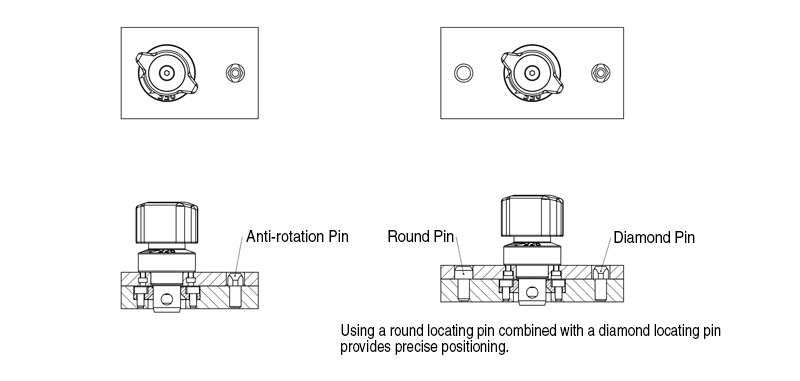
Yes, the product can be used with a single clamp and receptacle set.
However, we recommend using locating pins to prevent the plate from rotating.
Yes.
For plates thinner than 6 mm, installation is possible by using a spacer fabricated by the customer to match the plate thickness.
However, as the Heavy Duty model has a high clamping force, the mounting plate may deform or distort. Use caution when applying this product to thin plates.
Yes.
The high clamping force and wedge mechanism help suppress looseness and movement under vibration.
However, performance has not been verified under all vibration conditions. Please evaluate suitability through testing under your actual operating conditions.
No.
This product is not designed with dustproof or waterproof protection. If dust or water enters the internal mechanism, it may cause malfunction or component damage.
If necessary, please implement appropriate protective measures, such as installing covers, to prevent dust and water ingress.
Yes, for light-duty machining only.
Due to limitations in clamping force, this product is not suitable for heavy-duty cutting. However, it can be used for light machining operations, such as finishing with small-diameter end mills, drilling with small drills, or machining materials with good machinability such as aluminum or resin.
When using this product for machining applications, carefully control cutting conditions such as feed rate, spindle speed, and depth of cut.
If the cutting force exceeds the clamping force, workpiece displacement or reduced machining accuracy may occur.
No.
The knob of this product is secured with a locking bolt to prevent loosening due to vibration. Removal or replacement of the knob is not intended and is not recommended.
Any modification or replacement performed by the user may void the product warranty.
In addition, increasing the knob diameter may increase the operating torque and could lead to damage of internal components.